MAEZ guide
HVNL 2026 Changes and Chain of Responsibility Training Readiness: A Practical Guide for Australian Operators
From 1 August 2026, the amended Heavy Vehicle National Law mandates Safety Management Systems, introduces fit-to-drive duties, and restructures NHVAS accreditation. Here is what every CoR duty holder needs to do now to be ready.
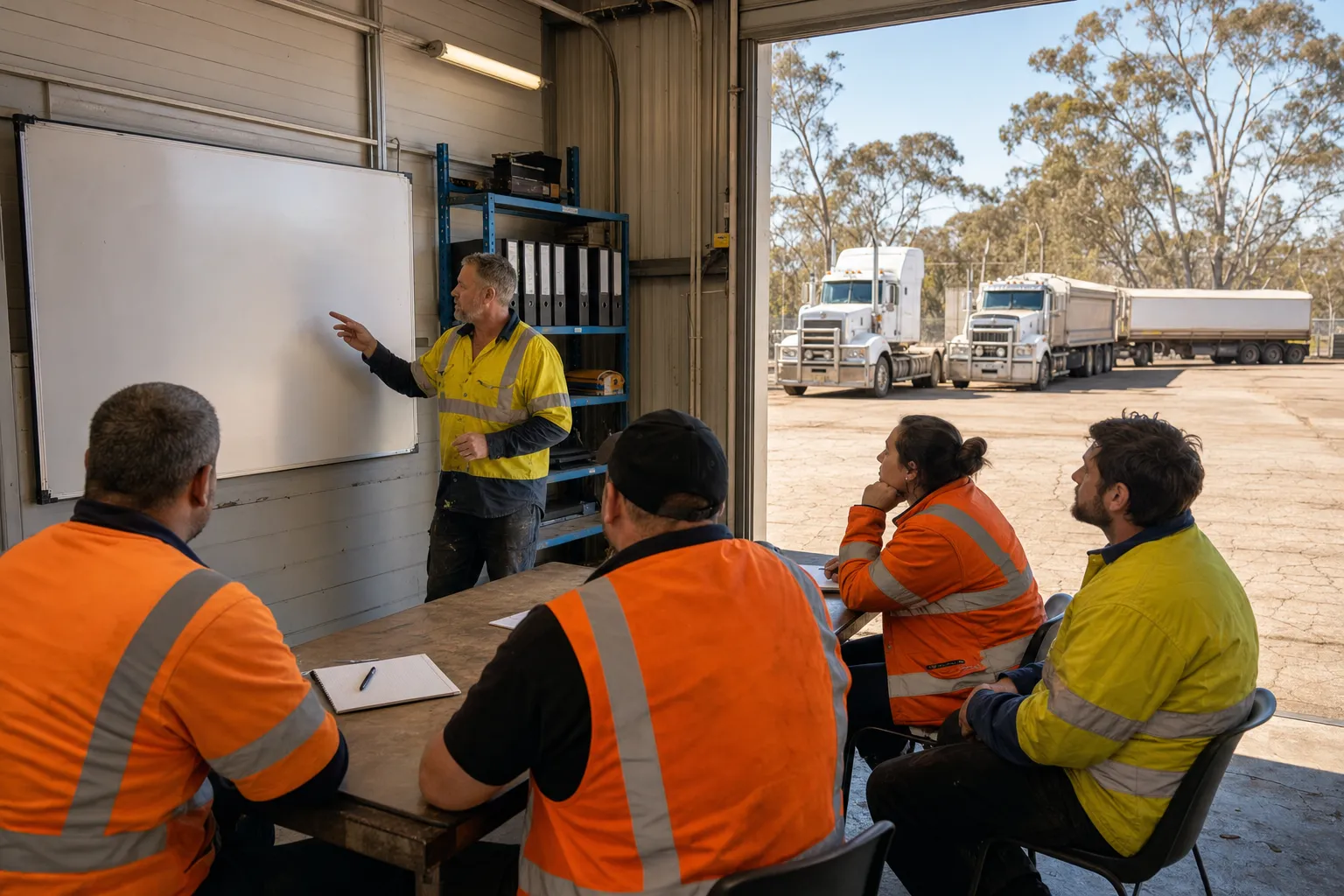
What are the HVNL 2026 changes and why do they matter for Chain of Responsibility training?
The amended Heavy Vehicle National Law (HVNL) commences on 1 August 2026, bringing the most significant regulatory shift in over a decade for Australian heavy vehicle operators. The changes mandate Safety Management Systems (SMS), introduce a fit-to-drive duty, restructure NHVAS accreditation, and sharpen executive liability under Chain of Responsibility (CoR) provisions. For operators, managers, and every party in the transport chain — consignors, consignees, packers, loaders, drivers, and operators — these changes mean that ad-hoc compliance practices will no longer be defensible. Training your people on what the law requires, and being able to evidence that training, becomes the baseline expectation.
MAEZ helps operators stop losing sleep over fines, accreditation risk, and scattered evidence by providing expert advisory, practical CoR training, chartered risk reviews, and a clear path to close gaps before the 2026 deadline.
Key takeaways
- The amended HVNL commences 1 August 2026 and will mandate Safety Management Systems for heavy vehicle operations, replacing voluntary arrangements with a structured, auditable obligation.
- Chain of Responsibility duties under the current HVNL (Part 1A, sections 26A–26E) already impose a primary duty on every party in the chain and a separate executive duty on officers of legal entities — the 2026 amendments strengthen enforcement and penalties.
- The NHVR is actively preparing implementation guidance, and the 2026 Master Code has been published to help operators manage hazards and risks in alignment with CoR law.
- NHVAS accreditation is being restructured; operators who rely on current accreditation modules should begin a gap review now to understand what will change.
- Training records, SMS documentation, and evidence of reasonable steps are the three pillars that protect duty holders from Category 1 and Category 2 offences under the HVNL.
What is Chain of Responsibility under the current HVNL?
The Chain of Responsibility is the legal framework in the Heavy Vehicle National Law that extends responsibility for heavy vehicle safety beyond the driver to every party who influences the transport task. The principle of shared responsibility is established in section 26A of the HVNL, which recognises that safety breaches are often caused by pressures and decisions made upstream of the driver.
Under section 26C, each party in the chain has a primary duty to ensure, so far as is reasonably practicable, the safety of heavy vehicle operations. This duty applies to consignors, consignees, packers, loaders, drivers, operators, and any other party whose acts or omissions influence the transport task. The duty is broad — it covers mass, dimension, loading, speed, fatigue, and general vehicle safety.
Section 26D imposes a separate duty on executives of legal entities. Officers must exercise due diligence to ensure the entity complies with its safety duties. This means executives cannot delegate away their personal liability by pointing to a compliance manager or a training program. They must actively understand the risks, ensure resources are allocated, and verify that systems are working.
Section 26E addresses prohibited requests and contracts — making it an offence to ask, direct, or contract a driver or another party to breach the HVNL. This provision catches consignors who impose unrealistic delivery deadlines that effectively require speeding or fatigue breaches.
For a deeper understanding of how these duties apply across the chain, see the About Chain of Responsibility | MAEZ guide.
What changes in the HVNL 2026 amendments?
The 2026 amendments, which take effect from 1 August 2026, build on the existing CoR framework but introduce several material changes that operators need to prepare for now:
Mandatory Safety Management Systems
The most significant change is the move from voluntary SMS to mandatory Safety Management Systems. Under the current HVNL, operators can choose whether to implement an SMS, and NHVAS accreditation modules provide a structured (but voluntary) pathway. From 1 August 2026, the amended law will require operators to have a documented, functioning SMS that identifies hazards, assesses risks, implements controls, and is reviewed regularly.
This is not a paperwork exercise. The SMS must be operational — meaning it must be embedded in day-to-day decision-making, not sitting on a shelf. Operators who currently rely on informal practices or undocumented procedures will need to formalise their approach. CoRGuard, the SaaS SMS platform available through MAEZ, provides a structured implementation path where software evidence is needed — but software alone does not remove liability. The SMS must reflect actual practice.
Fit-to-drive duty
The amendments introduce a fit-to-drive duty, which expands the existing fatigue framework (Chapter 6 of the HVNL) to address fitness for duty more broadly. The current fatigue provisions (sections 220–300+) already require drivers to manage work and rest hours, carry work diaries, and not drive while impaired by fatigue. The 2026 changes extend this concept to encompass a broader range of fitness considerations.
For current capability, MAEZ supports fatigue and driver diary checks — the Electronic Work Diary (EWD) is not yet live in the platform. Operators should focus on work diary record-keeping under Part 6.4 (section 293 and following) and ensure record keepers maintain the records required under section 321.
NHVAS accreditation restructuring
The NHVAS accreditation framework is being restructured to align with the new mandatory SMS requirements. Operators who currently hold NHVAS accreditation under modules such as Mass Management, Maintenance Management, or Fatigue Management should review their accreditation status and understand how the transition will work. The NHVR is preparing implementation guidance, and operators should monitor NHVR communications closely.
For practical support with NHVAS readiness, the Chain of Responsibility Consulting | Practical CoR Risk Review | MAEZ service provides a structured gap assessment.
Strengthened penalties and enforcement
The current HVNL already categorises offences into Category 1 (section 26F — exposing an individual to a risk of death or serious injury) and Category 2 (section 26G — exposing an individual to a risk of harm). The 2026 amendments are expected to strengthen enforcement tools and increase penalty exposure. Under the current law, Category 1 offences already carry significant penalties, and the executive duty in section 26D means officers can be personally prosecuted.
The defence provisions in the HVNL (including section 632, which addresses what a person ought reasonably to have known, and section 632A, which allows a code of practice to be used in proceedings) mean that documented evidence of reasonable steps is critical. Training records, SMS documentation, and audit trails are the evidence that supports a defence.
Who are the Chain of Responsibilities duty holders?
The term "Chain of Responsibilities" refers to the network of parties who each hold a duty under the HVNL. Understanding who holds a duty — and what that duty means operationally — is the foundation of CoR training. The key duty holders are:
- Consignor: The party who sends goods. Must ensure the transport task they are consigning does not create safety risks — for example, by providing accurate mass and dimension information and not setting delivery schedules that require breaches.
- Consignee: The party who receives goods. Must not impose conditions that pressure the driver or operator to breach the law — for example, by requiring unloading within an unrealistic timeframe.
- Packer: The party who packs or assembles goods for transport. Must ensure packing does not cause load restraint, mass, or dimension breaches.
- Loader: The party who loads goods onto the vehicle. Must ensure the load is placed, secured, and distributed to comply with mass, dimension, and loading requirements.
- Driver: The person who drives the heavy vehicle. Must comply with work and rest hours, carry and maintain a work diary, and not drive while impaired by fatigue.
- Operator: The person or entity responsible for the operation of the heavy vehicle. Holds the primary duty under section 26C and must ensure the vehicle is safe, maintained, and operated in compliance with the HVNL.
For a detailed breakdown of each role and its obligations, see Chain of Responsibilities: What Australian HVNL Duty Holders Need to Understand.
Why does Chain of Responsibility training matter for 2026 readiness?
Training is not a box-ticking exercise. Under the HVNL, the question of whether a duty holder took "reasonable steps" to prevent a breach is central to liability. Section 632 of the HVNL addresses how courts decide whether a person ought reasonably to have known something — and documented training is one of the strongest forms of evidence that a duty holder was aware of obligations and took steps to comply.
The 2026 Master Code, published by the NHVR, provides guidance on managing hazards and risks in alignment with CoR law. Using the Master Code as a reference in proceedings is contemplated by section 632A, which means that training aligned to the Master Code strengthens a duty holder's position.
Effective CoR training should cover:
- The specific duties under Part 1A of the HVNL (sections 26A–26E) and what they mean for each role
- The operational implications of mass, dimension, loading, speed, and fatigue management
- The executive duty (section 26D) and what due diligence looks like in practice
- How to identify and document reasonable steps
- The changes coming on 1 August 2026 and what they require operationally
For practical, role-specific training, MAEZ offers Chain of Responsibility Training for Australian Transport Operators and a dedicated Chain of Responsibility Course designed for real-world application. Training is also available through CoR Training for operators who need a structured, online pathway.
How does a Safety Management System support CoR compliance?
A Safety Management System is the structured framework that ties CoR obligations together. Under the 2026 amendments, an SMS will be mandatory — but even under the current HVNL, having a functioning SMS is the most effective way to demonstrate reasonable steps and support a defence under sections 632 and 632A.
An effective SMS should include:
- Hazard identification and risk assessment: Documented processes for identifying safety hazards across mass, dimension, loading, fatigue, speed, and vehicle maintenance.
- Controls and procedures: Written procedures that address each identified risk, with clear allocation of responsibility.
- Training and competency: Records showing that each person in the chain has been trained on their specific duties and the procedures that apply to them.
- Monitoring and review: Processes for checking that controls are working — including internal audits, driver feedback loops, and incident reporting.
- Documentation and evidence: A centralised, accessible record of all SMS elements that can be produced if requested by the NHVR or an authorised officer.
The Chartered Risk Review for Chain of Responsibility Gaps provides a structured methodology for identifying where your SMS falls short of what the HVNL requires.
For executives and managers specifically, the Chain of Responsibility Training for Executives and Managers guide explains what due diligence under section 26D looks like in practice and how to evidence it.
What should operators do now to prepare for 1 August 2026?
Operators should not wait until the amended law takes effect. The period between now and 1 August 2026 is the window to build the systems, train the people, and close the gaps that will prevent liability under the new framework. Here is a practical, phased approach:
Phase 1: Understand your current position (now)
- Identify every party in your transport chain and confirm who holds a duty under sections 26C and 26D.
- Review your current NHVAS accreditation status and understand which modules you hold.
- Conduct a gap assessment against the current HVNL CoR provisions and the 2026 Master Code.
Phase 2: Close the gaps (next 3–6 months)
- Implement or upgrade your SMS so it covers hazard identification, risk assessment, controls, training, monitoring, and documentation.
- Deliver role-specific CoR training to every person in the chain — consignors, loaders, drivers, schedulers, and executives.
- Document everything. Training records, procedure acknowledgements, and audit findings are your evidence of reasonable steps.
Phase 3: Verify and evidence (6–12 months before commencement)
- Conduct an internal audit of your SMS and training records.
- Test your documentation against the questions an NHVR investigator would ask: Can you show what hazards you identified? Can you show what controls you implemented? Can you show who was trained and when?
- Use CoRGuard at chainresponsibility.au to centralise your SMS evidence if software-supported documentation is needed.
Phase 4: Maintain and review (ongoing)
- Schedule regular reviews of your SMS, training, and evidence.
- Monitor NHVR communications for implementation guidance and transition arrangements.
- Keep training current — refresher training should be scheduled at least annually and whenever roles, procedures, or legal requirements change.
What is the MAEZ approach to CoR readiness?
MAEZ is the expert advisory, training, and chartered risk offering for Australian transport operators. The approach is practical and evidence-based:
- Advisory: We help you understand your obligations under the current HVNL and the 2026 amendments, mapped to your specific operation.
- Training: We deliver Chain of Responsibility Training that is role-specific and grounded in the HVNL, the Master Code, and real-world operational scenarios.
- Chartered Risk Review: We conduct a structured gap assessment using a chartered risk lens to identify where your systems, training, and evidence fall short of what the law requires.
- CoRGuard: Where software-supported evidence is needed, the CoRGuard SMS platform provides a structured implementation path.
The goal is not to sell software or guarantee compliance — no software can remove your legal liability. The goal is to ensure that when the NHVR asks whether you took reasonable steps, you can produce the evidence.
How does training reduce liability under the HVNL?
Under the HVNL, liability is determined by reference to whether a duty holder knew, or ought reasonably to have known, that a breach was occurring or was likely to occur. Section 632 of the HVNL sets out how this is determined. Training is the mechanism by which a duty holder ensures their people know what the law requires and what they must do to comply.
Without training, a duty holder cannot credibly claim they took reasonable steps. With documented, role-specific training aligned to the Master Code and the HVNL, a duty holder can demonstrate that:
- Each person in the chain understood their specific obligations.
- The entity had systems in place to identify and manage risks.
- The executive exercised due diligence under section 26D by ensuring training was delivered and verifying its effectiveness.
For operators who need to move quickly, Contact MAEZ to discuss a tailored readiness plan.
What are the current fatigue and work diary obligations operators must manage?
Under Chapter 6 of the HVNL, fatigue-regulated heavy vehicle drivers must comply with work and rest hour requirements, carry a work diary (section 293), and record required information including odometer readings and work/rest periods. Record keepers must maintain the records specified in section 321 and ensure information is provided by drivers in accordance with sections 322–324.
The current capability for fatigue management in the MAEZ/CoRGuard ecosystem focuses on fatigue and driver diary checks — the Electronic Work Diary is not yet live. Operators should ensure that:
- Drivers are trained on work diary requirements and the consequences of false or misleading entries (section 325).
- Record keepers maintain complete and accurate records and can produce them if requested.
- Schedulers and planners are trained on how their decisions affect driver fatigue and how to avoid creating schedules that require breaches.
The 2026 amendments will expand the fatigue framework to include the fit-to-drive duty, so operators should begin building fatigue management into their SMS now rather than treating it as a standalone compliance task.
What are the penalties for CoR breaches under the HVNL?
The HVNL classifies CoR breaches into categories based on the level of risk:
- Category 1 offences (section 26F): Involve conduct that exposes an individual to a risk of death or serious injury or serious illness. These carry the highest penalties.
- Category 2 offences (section 26G): Involve conduct that exposes an individual to a risk of harm (less serious than Category 1 but still significant).
- Category 3 and 4 offences: Lower-level breaches with correspondingly lower penalties.
Executives can be personally liable under section 26D if they fail to exercise due diligence. The corporate entity can also be liable, and the HVNL provides for liability of executive officers of corporations (section 636).
The 2026 amendments are expected to increase penalty exposure, making it more important than ever to have documented evidence of reasonable steps — including training records, SMS documentation, and audit trails.
Frequently asked questions
When do the HVNL 2026 changes take effect?
The amended Heavy Vehicle National Law commences on 1 August 2026. From that date, Safety Management Systems will be mandatory, the fit-to-drive duty will apply, and NHVAS accreditation will be restructured. Operators should begin preparing now — building an SMS, delivering CoR training, and documenting evidence of reasonable steps.
Who needs Chain of Responsibility training?
Every party in the transport chain needs CoR training tailored to their role. This includes consignors, consignees, packers, loaders, drivers, operators, schedulers, and executives of legal entities. Under section 26D of the HVNL, executives have a personal due diligence duty, which means they must understand the risks and ensure the entity is complying. Training should be documented and refreshed at least annually.
Is NHVAS accreditation mandatory under the current HVNL?
No. Under the current HVNL, NHVAS accreditation is voluntary and provides a structured pathway for operators who want to demonstrate compliance with mass, maintenance, and fatigue management standards. However, the 2026 amendments will restructure NHVAS and make Safety Management Systems mandatory, so operators who currently rely on NHVAS should review their position and plan for the transition.
What is a Safety Management System under the HVNL?
A Safety Management System (SMS) is a structured framework for identifying hazards, assessing risks, implementing controls, and monitoring and reviewing performance. Under the 2026 HVNL amendments, an SMS will be mandatory for heavy vehicle operators. An effective SMS includes documented procedures, training records, monitoring processes, and evidence that can be produced if requested by the NHVR. The 2026 Master Code published by the NHVR provides guidance on what an SMS should address.
Can software guarantee CoR compliance?
No. Software cannot guarantee compliance or remove a duty holder's legal liability under the HVNL. Software such as CoRGuard at chainresponsibility.au can support the implementation and documentation of an SMS, but compliance depends on the duty holder's actual conduct, the effectiveness of their systems, and their ability to demonstrate reasonable steps. MAEZ does not provide legal advice or guarantee compliance outcomes.
How often should CoR training be refreshed?
CoR training should be refreshed at least annually and whenever there is a material change — for example, when the HVNL is amended (such as the 1 August 2026 changes), when a person's role changes, when procedures are updated, or when an incident reveals a gap. Documented refresher training is a key piece of evidence that a duty holder is maintaining due diligence under section 26D.
What records should an operator keep to demonstrate reasonable steps?
Operators should maintain training records (who was trained, when, what was covered, and acknowledgement of understanding), SMS documentation (hazard identification, risk assessments, controls, and review records), work diary and fatigue records (under sections 293 and 321), audit findings and corrective actions, incident reports, and any communications with the NHVR. These records should be centralised, accessible, and current — scattered evidence is a liability.
Practical next steps
- Book a CoR training session: Visit CoR Training or Chain of Responsibility Training for Australian Transport Operators | MAEZ to schedule role-specific training for your team.
- Conduct a gap review: Use the Chartered Risk Review for Chain of Responsibility Gaps methodology to identify where your systems and evidence fall short.
- Implement or upgrade your SMS: Whether you use CoRGuard at chainresponsibility.au or another approach, ensure your SMS is documented, operational, and aligned to the 2026 Master Code.
- Train your executives: Ensure officers understand their due diligence duty under section 26D. The Chain of Responsibility Training for Executives and Managers guide explains what this looks like.
- Contact MAEZ: If you are not sure where to start, Contact MAEZ for a tailored readiness assessment.
The 1 August 2026 deadline is not a future problem. It is a current planning obligation. The operators who start now will be the ones who can sleep soundly when the amended law takes effect.
Frequently asked questions
Practical answers
- When do the HVNL 2026 changes take effect?
- The amended Heavy Vehicle National Law commences on 1 August 2026. From that date, Safety Management Systems will be mandatory, the fit-to-drive duty will apply, and NHVAS accreditation will be restructured.
- Who needs Chain of Responsibility training?
- Every party in the transport chain needs role-specific CoR training, including consignors, consignees, packers, loaders, drivers, operators, schedulers, and executives. Under section 26D of the HVNL, executives have a personal due diligence duty and must understand the risks and ensure the entity is complying.
- Is NHVAS accreditation mandatory under the current HVNL?
- No. Under the current HVNL, NHVAS accreditation is voluntary. However, the 2026 amendments will restructure NHVAS and make Safety Management Systems mandatory, so operators should review their position now.
- What is a Safety Management System under the HVNL?
- A Safety Management System is a structured framework for identifying hazards, assessing risks, implementing controls, and monitoring and reviewing performance. Under the 2026 HVNL amendments, an SMS will be mandatory for heavy vehicle operators.
- Can software guarantee CoR compliance?
- No. Software cannot guarantee compliance or remove a duty holder's legal liability under the HVNL. Software such as CoRGuard can support SMS implementation and documentation, but compliance depends on the duty holder's actual conduct and ability to demonstrate reasonable steps.
- How often should CoR training be refreshed?
- CoR training should be refreshed at least annually and whenever there is a material change — such as HVNL amendments, role changes, procedure updates, or incidents that reveal gaps.
- What records should an operator keep to demonstrate reasonable steps?
- Operators should maintain training records, SMS documentation, work diary and fatigue records under sections 293 and 321, audit findings, corrective actions, and incident reports. These should be centralised and accessible.